
The way businesses create content is changing fast. A few years ago, simply posting regularly on social media was enough to stay visible. But in 2026, audiences are more informed, more selective, and far less interested in generic content.
If your content is not educating, solving problems, or building trust, it will most likely be ignored. Brands that win today are the ones that focus on meaningful content that helps people make better decisions.
In other words, content should no longer exist just to fill your feed — it should work as a strategic tool to attract, engage, and convert your audience.
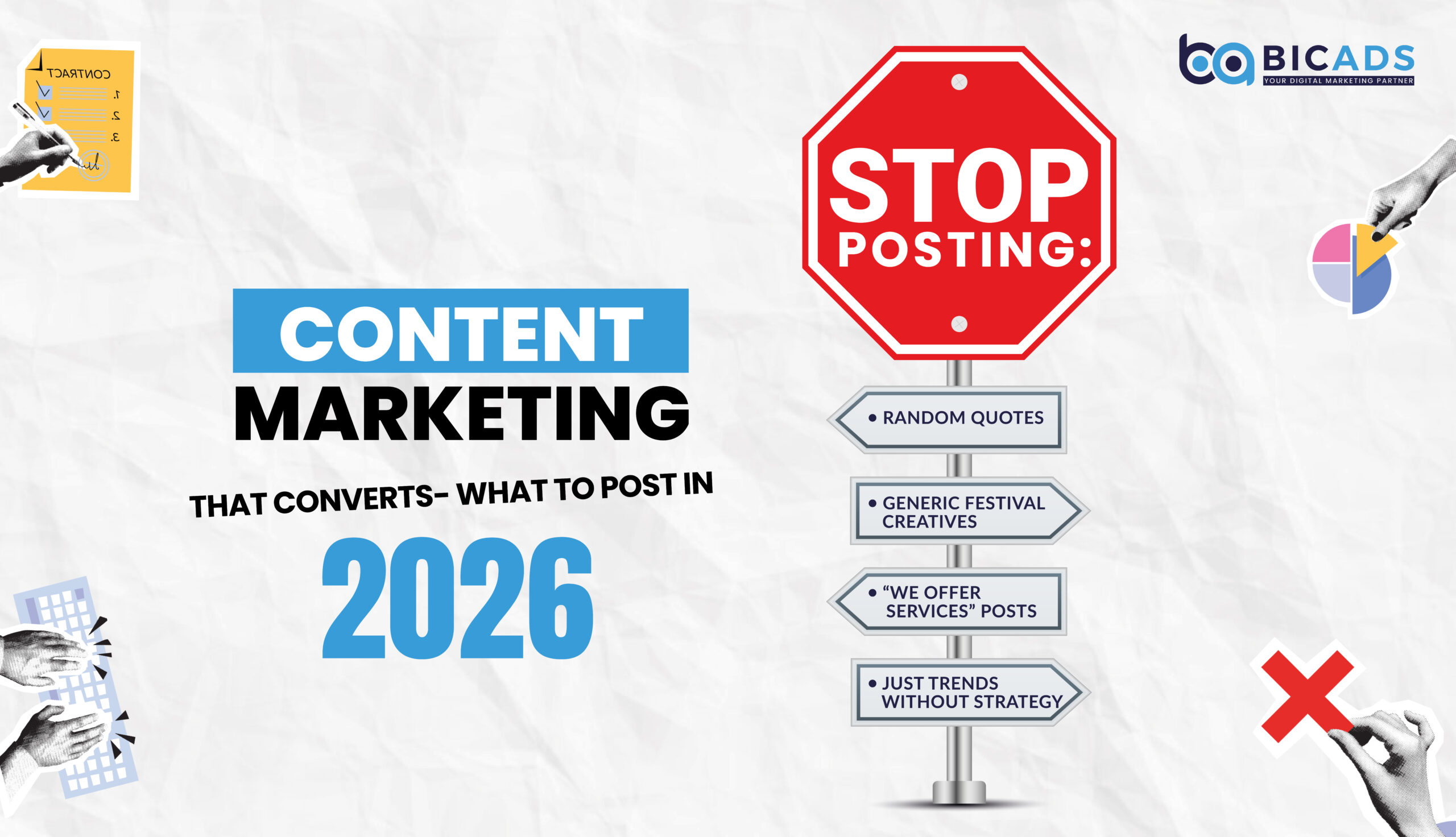
Before understanding what works, let’s first look at what brands should stop doing.
Content That No Longer Works in 2026
Many businesses still rely on content formats that once performed well but now bring very little value.
Random motivational quotes may collect a few likes, but they rarely build authority or attract serious prospects.
Generic festival creatives often look identical across brands and fail to communicate anything unique about your business.
“We offer services” posts focus only on selling instead of explaining why your solution matters.
Jumping on trends without strategy may create temporary engagement but rarely leads to meaningful conversations or conversions.
If your goal is to generate real leads and build credibility, your content needs to evolve.
Here’s what brands should start focusing on instead.
1. Problem-Based Content
People pay attention to content that reflects their challenges. When your audience sees their problems being described clearly, they immediately feel understood.
Problem-based content focuses on identifying the struggles your audience faces and offering insight into why those problems exist.
For example, a marketing agency might post something like:
“Why your ads are not generating leads even after spending ₹50,000.”
This type of content works because it highlights a real issue many businesses face. It sparks curiosity and encourages readers to understand what might be going wrong.
Instead of promoting your services directly, you’re starting a conversation around a real problem — and that naturally attracts the right audience.
2. Authority-Building Content
In today’s digital landscape, people rarely trust claims without evidence. That’s why authority-building content is essential.
This type of content focuses on demonstrating your expertise through real examples, results, and experiences.
Some effective formats include:
- Detailed case studies explaining how you solved a client’s problem
- Before-and-after performance comparisons
- Client testimonials describing their experience
- Strategy breakdowns that explain how results were achieved
For example, a post might highlight:
“How a small e-commerce brand increased website leads by 120% in 3 months using a redesigned landing page.”
When people see proof of your expertise, they feel more confident about working with you. At the end of the day, people don’t just buy services — they buy confidence in the person delivering them.
3. Behind-the-Scenes Strategy Content
Many brands show the final result of their work but rarely reveal the thinking behind it. However, audiences today appreciate transparency.
Behind-the-scenes strategy content focuses on explaining how decisions are made and why certain strategies work.
For instance, you might share insights such as:
“How we structure a high-converting landing page for service-based businesses.”
Instead of simply showing a finished design, you could explain elements like:
- Why the headline focuses on a specific customer pain point
- How testimonials increase credibility
- Why the call-to-action is placed in multiple sections of the page
This kind of content helps people understand your thought process and demonstrates that your work is backed by strategy rather than guesswork.
Transparency builds trust, and trust drives conversions.
4. Educational Micro-Value Content
Not every piece of content needs to be long or complex. Sometimes, the most engaging posts are short insights that provide immediate value.
Educational micro-value content focuses on sharing small but powerful tips that your audience can apply instantly.
For example:
“Change this one line in your landing page headline to increase conversions.”
You could then explain how shifting the headline from a generic statement like:
“We provide the best digital marketing services”
to a benefit-driven message like:
“Get consistent leads without increasing your ad budget.”
can make a significant difference.
These quick insights are highly shareable and position your brand as a helpful resource. Over time, consistently providing practical knowledge helps establish strong credibility.
5. Opinion-Based Content
One of the biggest shifts in content marketing is the rise of opinion-driven content. Brands that confidently share their perspectives tend to attract more attention and discussion.
Instead of playing it safe, businesses are increasingly sharing bold insights based on their experience.
For example, a post might say:
“Boosting posts is not a marketing strategy.”
This type of statement encourages people to question common practices and engage in conversation.
Opinion-based content works best when it is supported by reasoning, experience, or real-world examples. The goal isn’t to create controversy, but to offer thoughtful perspectives that challenge outdated ideas.
When done well, it helps position your brand as a leader rather than just another voice in the crowd.
The Content Formula That Works in 2026
Behind every successful piece of content is a clear structure. One of the most effective frameworks for creating impactful content in 2026 is:
Hook → Problem → Insight → Proof → Call to Action
Here’s how it works:
Hook: Start with a compelling statement or question that immediately grabs attention.
Problem: Address a challenge your audience commonly faces.
Insight: Provide useful information or a unique perspective.
Proof: Support your point with examples, results, or data.
Call to Action: Guide the reader on what step to take next.
For example:
Hook: “Spending thousands on ads but still not getting leads?”
Problem: Many businesses run ads without optimizing their landing pages.
Insight: A simple change in messaging can significantly improve conversions.
Proof: A recent campaign improved lead generation by 80% after updating the page structure.
CTA: “Review your landing page messaging before increasing your ad budget.”
When each of these elements is present, your content becomes far more effective.
Because the truth is simple:
No hook means no attention.
No proof means no trust.
No call to action means no conversions.