

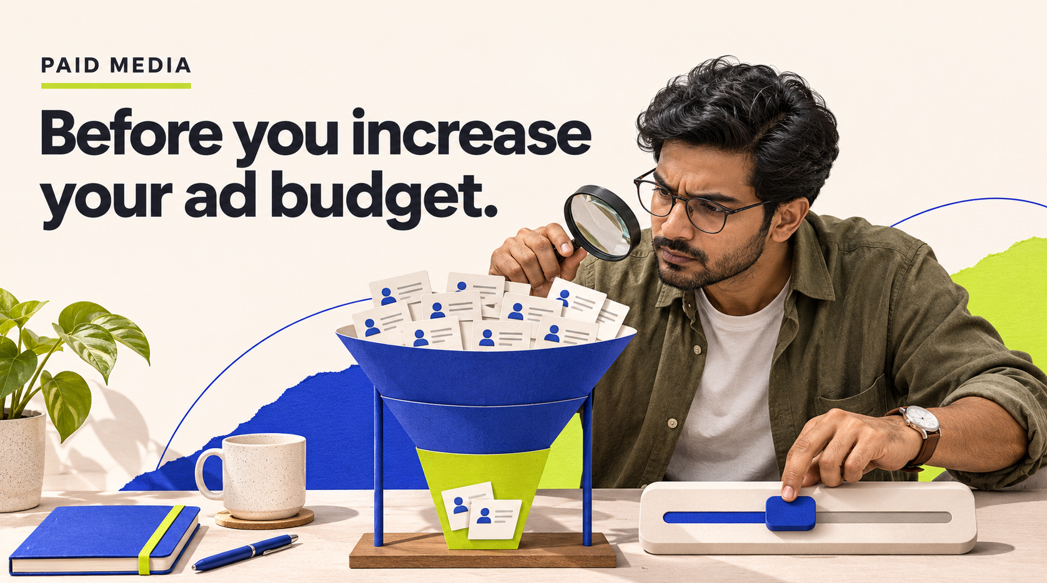
Your campaign brought in more enquiries this month. The sales team is busy, the cost per lead looks reasonable, and someone suggests increasing the ad budget.
Before approving it, ask what the extra money needs to achieve. More qualified sales conversations? More site visits? More customers within an affordable acquisition cost?
Increase your ad budget when you can measure a useful business outcome, current performance supports the additional spend, and your team can handle the extra demand. Agree on the outcome, cost limit and review date before making the change.
A higher enquiry count gives you a starting point. Following those enquiries through to sales gives you a budget decision.
How do you know if your ads are working
Start with the decision your customer has to make. A preschool franchise needs enquiries from people who have the investment capacity, a suitable location and a realistic opening timeline. A B2B manufacturer needs enquiries for applications it can serve, from companies with a genuine project.
Write down what makes an enquiry worth pursuing. Marketing and sales should use the same definition when reviewing campaign results.
Then choose the main outcome for the budget increase. If your sales cycle takes several months, qualified opportunities may be the earliest useful measure. Keep tracking those opportunities until you can assess signed orders and acquisition cost.
For a campaign focused on awareness, agree on audience reach and a credible way to evaluate its effect on future demand. Match the measurement to the campaign’s job.
Which lead generation KPIs should you track before increasing ad spend
A monthly report becomes easier to use when each number answers a specific question.
| Metric | What it tells you | What to check alongside it |
| Cost per lead | Ad spend divided by recorded leads | Duplicate entries and lead suitability |
| Qualification rate | Qualified leads divided by total leads | Consistent qualification criteria |
| Cost per qualified lead | Ad spend divided by qualified leads | Progress into meetings and proposals |
| Lead to customer conversion rate | Customers divided by leads from the same group | Enough time for the sales cycle to finish |
| Ad spend per acquired customer | Attributable ad spend divided by customers acquired | Sales and marketing costs beyond media spend |
| Customer acquisition cost | Relevant sales and marketing acquisition costs divided by new customers | Margins, collection timing and retention |
Keep the cost definitions consistent. If a report includes only advertising spend, label it “ad spend per acquired customer”. A fuller customer acquisition cost calculation also accounts for the relevant sales and marketing costs.
Compare leads acquired over a defined period with their eventual outcomes. Dividing this month’s spend by this month’s sales can mix recent enquiries with customers acquired through much older campaigns.
What is a good cost per qualified lead for your business
An affordable lead cost depends on how often suitable leads become customers and what the business can afford to spend acquiring each customer.
Suppose, purely as a planning example, that you set a maximum advertising cost of ₹6,000 per acquired customer. Your historical data shows that one in five qualified leads becomes a customer.
That gives you a working cost ceiling of ₹1,200 per qualified lead.
₹6,000 × 20% = ₹1,200
This calculation assumes the conversion rate holds as spend grows. Revisit it when lead quality, close rates or margins change. Check that the ₹6,000 allowance leaves room for selling costs, delivery costs and the profit the business needs.
Use your own sales records to set this limit. A competitor’s reported cost per lead gives you little information about what your business can afford.
Why are you getting more leads but fewer sales
Consider this illustrative comparison. Both groups of leads have had enough time to complete the sales cycle, and the qualification rules are identical.
| Result | Before the increase | After the increase |
| Ad spend | ₹50,000 | ₹75,000 |
| Enquiries | 200 | 300 |
| Cost per enquiry | ₹250 | ₹250 |
| Qualified leads | 40 | 45 |
| Cost per qualified lead | ₹1,250 | Approximately ₹1,667 |
| Customers acquired | 8 | 9 |
| Ad spend per acquired customer | ₹6,250 | Approximately ₹8,333 |
The enquiry report shows 50% growth at a stable cost per lead. The sales report shows one additional customer.
In this example, the extra ₹25,000 produced five additional qualified leads and one additional customer. That makes the advertising cost of the additional customer ₹25,000.
This is why the next budget decision needs both the overall average and the return from the additional spend. Whether ₹25,000 is acceptable depends on the customer’s value and the business’s acquisition cost limit.
These figures demonstrate the calculation. Actual results also depend on factors such as seasonality, offer changes and sales execution.
Should you increase your Google Ads budget if it is limited by budget
A “limited by budget” status means there may be additional demand your current budget is restricting. Review the quality and acquisition cost of the conversions you already get before approving an increase.
If a campaign is generating suitable enquiries within your cost limit and sales can handle more, an increase is worth testing. If it is spending well below the existing budget, raising that limit alone may have little effect. Check search demand, targeting and campaign delivery first. Google’s guidance on advertising budgets explains how spending constraints and budget forecasts inform this decision.
Should you increase your Meta Ads budget when leads are cheap
Review the enquiries in your CRM before increasing the budget. Check whether the contacts meet your qualification criteria, reply to follow-up and progress into sales conversations.
For example, a franchise campaign may produce low-cost enquiries from people whose available investment falls below the franchise requirement. Test clearer investment information and qualifying questions, then review the results. An affordable cost per qualified enquiry provides a stronger basis for increasing spend.
What should you check before scaling ad campaigns
Test the enquiry path yourself. Submit the form, make a test call where appropriate, and confirm that the enquiry reaches the person responsible for follow-up. Check that repeated submissions and duplicated tracking events are handled correctly.
Keep the campaign source attached to the lead as it progresses through your CRM or tracking sheet. Record qualification, meeting attendance, proposal status and the eventual sale.
Google Ads supports qualified lead and converted lead goals using offline outcome data. These can help connect campaign activity with later steps in the sales process. See Google’s guidance on qualified leads and converted leads.
Check which actions your campaigns use for bidding. A download, a submitted enquiry and a qualified opportunity represent different levels of commitment. Choose an action that suits the objective and has reliable measurement.
Also check sales capacity. Agree who owns each enquiry, how quickly they should respond and what happens when the first contact attempt fails. Additional demand needs time in the team’s calendar.
How much should you increase your ad budget
Give the proposed increase a short written brief. It should state the additional amount, the outcome you want, the acceptable cost, who will follow up and when you will evaluate it.
For example, a business could test an additional ₹15,000 with an agreed target for qualified meetings. It would review lead suitability and response handling early, then assess sales outcomes once those leads have had time to progress.
There is no single review period that suits every business. Use your normal time from enquiry to the outcome you are measuring. Recent campaign data may still be missing conversions that happen later, as Google explains in its guidance on conversion lag reporting.
Keep a record of changes to the offer, landing page, targeting and sales process during the test. Those changes affect how confidently you can attribute a result to the budget increase.
Frequently asked questions about increasing ad budgets
Will increasing my ad budget increase sales
A larger budget may increase sales when there is additional suitable demand, the offer converts and sales can handle the enquiries. Review qualified leads and acquired customers after allowing for your sales cycle. More spend alone cannot establish whether those conditions exist.
Is a low cost per lead a reason to spend more
Check qualification and sales outcomes first. A low cost per lead can support a budget increase when enough of those leads become suitable opportunities and customers at an affordable cost.
How much should you increase the budget
Choose a test amount the business can afford to evaluate, based on current conversion volume, available demand and sales capacity. Record what the additional spend must achieve. A fixed percentage cannot account for every campaign’s economics.
What if the sales cycle is too long to judge sales immediately
Review earlier evidence such as qualified meetings and accepted opportunities while continuing to track closed deals. Compare groups of leads at similar ages so each has a fair opportunity to convert.
Put the success criteria in the budget proposal
Before approving additional spend, ask for one sentence that defines the expected outcome, its acceptable cost and the date it will be reviewed. Then make sure the report can measure each part.
BICADS works with businesses on paid campaigns and lead generation across Pune and Mumbai. Explore our PPC and performance marketing services.
Bring your campaign report and the sales outcomes you have, and talk to BICADS about your next budget decision.

